


Take your show beyond the studio and into high-traffic, high-visibility event environments
Record Podcasts Where the People Already Are
One of the biggest limitations in podcasting has always been location. Traditional podcasts work best in quiet, controlled environments, but audience attention is often strongest in public, high-energy places like expos, conferences, and festivals. Silent disco headphones for podcasts make it possible to bring the show directly into those environments without giving up clarity.
This approach changes the question from “Where is it quiet enough to record?” to “Where can this show make the biggest impact?” Quiet Events describes this technology as a way to bring studio-quality audio into some of the loudest settings imaginable, which makes it especially valuable for brands, live creators, and event-based productions.

A straightforward routing setup makes production easier for teams that already have a mixer and laptop workflow
Use a Simple Signal Chain for Live Podcasting
A strong live setup needs to be reliable, but it also needs to be practical. Quiet Events explains that the signal routing is simple: a standard mixer or audio interface sends the audio output both to the laptop for recording or livestreaming and to the RF transmitter for headphone listening. From there, the transmitter sends the feed wirelessly to every pair of headphones in range.
That matters because it means creators do not need a completely new production system. They can keep the podcast workflow they already use while adding a silent listening layer for the live audience. For brands and event marketers, that makes the setup easier to deploy quickly and more realistic to use in temporary, mobile, or pop-up environments.

Real-time sound keeps interviews natural and prevents awkward timing issues during live conversation
Eliminate Delay With RF-Based Audio
One of the most important technical advantages in this kind of setup is latency. Bluetooth audio can introduce delay, which becomes distracting when people are trying to speak, listen, and respond in real time. Quiet Events specifically emphasizes that its system uses high-frequency RF rather than Bluetooth, creating a zero-lag listening experience.
For podcasting, that is a major benefit. Hosts can hear themselves and their guests immediately, which keeps the rhythm of the conversation intact. Producers can trust what people are hearing in the moment. Audiences get a cleaner, more natural listening experience, and the entire show feels more polished because the timing stays tight.

Make your setup more visible, more interactive, and more inviting to people walking by
Turn Your Podcast Booth Into a Crowd Magnet
A traditional podcast booth can look interesting, but it often feels closed off to people passing by. They see hosts talking, but they cannot hear what is being said, so they keep walking. Quiet Events describes this as a “dead” space. Silent disco headphones change that by making it easy for passersby to put on a headset and instantly connect with the content.
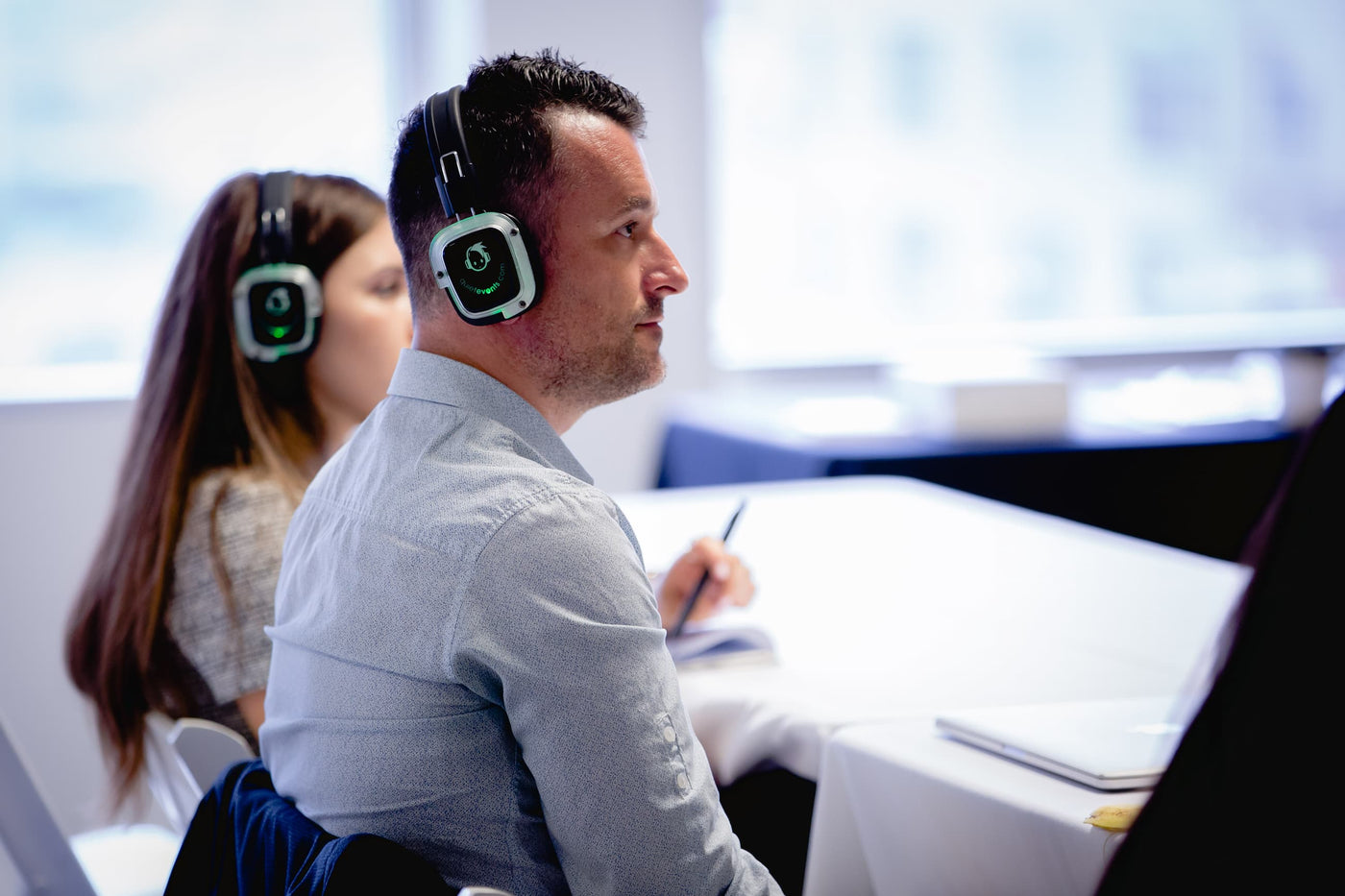
That shift is important for audience engagement. It turns the booth from a passive visual into an active listening experience. The glowing headphones also add a visual layer that naturally attracts attention, helping the activation stand out in a busy venue where every brand is competing for time and traffic.

Hear exactly what the digital audience hears, even in overwhelming event noise
Monitor the Processed Audio in Real Time
Monitoring is one of the hardest parts of live podcasting in noisy venues. Even if the microphones are positioned well, hosts can struggle to judge volume, vocal clarity, and overall sound quality when the room around them is loud. Quiet Events highlights that its headphones allow hosts and guests to hear the processed audio feed directly, which means they can monitor the show the same way the digital audience hears it.
This improves confidence and reduces mistakes. If something sounds off, the team can catch it immediately instead of discovering the problem later in the recording. That kind of real-time monitoring is especially valuable for interviews, sponsor activations, panel conversations, and any live production where one bad segment can affect the final content.

Create a polished listening environment without renting a permanent soundproof space
Build a Pop-Up Podcast Studio Almost Anywhere
One of the most compelling ideas in the source material is the concept of a “pop-up” studio. Quiet Events explains that creators no longer need to rely on expensive, cramped soundproof booths because the headphones themselves help create a virtual studio environment for each listener. That allows live broadcasting from places like trade floors, street corners, and rooftops while still maintaining a more intimate, high-end feel.
For marketers and creators, this is more than a technical improvement. It is a format upgrade. It opens the door to more mobile productions, more memorable brand experiences, and more flexibility in how and where content gets recorded.

One silent disco system can support podcast audio, translation, and supporting content at the same time
Use Multiple Audio Channels for Greater Flexibility
Another reason silent disco headphones for podcasts work so well in live settings is channel flexibility. Quiet Events states that the headphones support three channels. In the example provided, the blue channel can carry the podcast, the green channel can provide live translation, and the red channel can play curated background music for people waiting between segments.
This kind of flexibility is useful for conferences, international events, sponsor activations, and audience-first experiences. Instead of treating the live audience as one uniform group, the setup allows the event team to design multiple listening experiences around the same podcast environment. That gives the activation more range and makes it easier to serve different audience needs without adding separate physical infrastructure.

Support intimate listening groups or large audiences without changing the core concept
Scale From Small Podcast Crowds to Large Event Activations
Scalability is one of the strongest arguments for using silent disco technology in event-based podcasting. Quiet Events notes that the system can support small groups or very large audiences within a substantial radius. That makes it practical for both a focused VIP experience and a much broader public activation.
In other words, the format does not only work for small podcast booths. It can also support conference content stages, branded interview lounges, fan engagement spaces, and large event environments where reach matters just as much as sound quality. That scalability makes it especially attractive for companies that want to use podcasting as part of a bigger experiential strategy.

The listening device itself can help draw attention and reinforce the activation
Make the Headphones Part of the Visual Branding
Podcasting is usually audio-first, but in live event environments, visuals matter too. Quiet Events highlights that the glowing LED headphones act like “human billboards,” helping draw curiosity and traffic to the booth. That gives the setup an advantage over traditional podcast formats that may sound good internally but do not naturally stand out from across the room.
For event marketers, that means the hardware is doing more than delivering audio. It is also helping with visibility, crowd interest, and brand recall. In crowded venues where people make split-second decisions about what to approach, that visual signal can be just as valuable as the audio technology itself.
-

12 Hours
Battery Life (fully charged)
-

3,10 & 45 Channels
Of Audio w/ LED Lights
-

Individual Transmitters
Per Channel that can be Placed Anywhere
-

Works up to over 1,500 feet
From the base (over 4 football fields long)
-

All headphones come sanitized
And fully charged
-

Over the ear style
Cutting down on most outside noise
-

Simple setup
All you need to do is just Plug & Play
-

Professional sound quality
(Less than 1% distortion)
-

Anti-theft device
Installed to ensure headphones are returned


Shop the best Silent Disco headphones
View all-


Wireless Home Audio Silent Disco System
$560.00 CAD$632.00Unit price /Unavailable -

Wireless Home Audio Silent Disco System (TV & Projectors) - 10 Pack
$1,893.00 CADUnit price /Unavailable -

 Clearance
Ultra2 600 (13CH) - Silent Disco Headphone (ADA Compliant)
$50.00 CADUnit price /Unavailable -


Ultra 900 Transmitter - USED (10CH) - Silent Disco
$139.00 CADUnit price /Unavailable -


USB-C (Fast Charging) - 20 Headphone Charging AC Wall Set Power Adapter (Ultra1, Ultra2, 600, & 900)
$52.00 CADUnit price /Unavailable -


Ultra2 900 - USED (13CH) - Silent Disco Headphone - (ADA Compliant)
$50.00 CADUnit price /UnavailableBuy NewBuy Used


