
Quick Summary — you only need three things for a successful silent disco:
- Silent disco headphones. Check out Choosing the Right Silent Headphone System for Your Event to make sure you have the right one for the type of event you are hosting.
- A silent disco transmitter. One transmitter can support unlimited headphones.
- An audio player with music. You can hire a DJ, but it's not required.

Things to consider and common questions when hosting a silent disco
- How many channels / audio sources do you want? Do you want people to be able to switch between more than one type of music? If so, you'll need three transmitters and three audio sources.
- Do you want a live DJ? Live DJs are great for changing the music on the spot, but you can do the same by connecting your phone or laptop and playing from your own library, Spotify, YouTube Music, or even the free music library companies like Quiet Events offer.
- Is it a public event where you need to get all the headphones back? If so, using a company that works with ChxItOut is a solution.
- Do I need Wi-Fi? No. The headphones use radio frequency (RF) technology and don't rely on the internet at all.
- Do I need power? No. The headphones and transmitters have a 12-hour internal battery for all-day use.
- Can I make announcements to everyone? Yes. Some transmitters include a built-in microphone, so you can talk over the audio to everyone wearing a headphone on that transmitter's channel.
How to quickly set up a DIY silent disco system at home
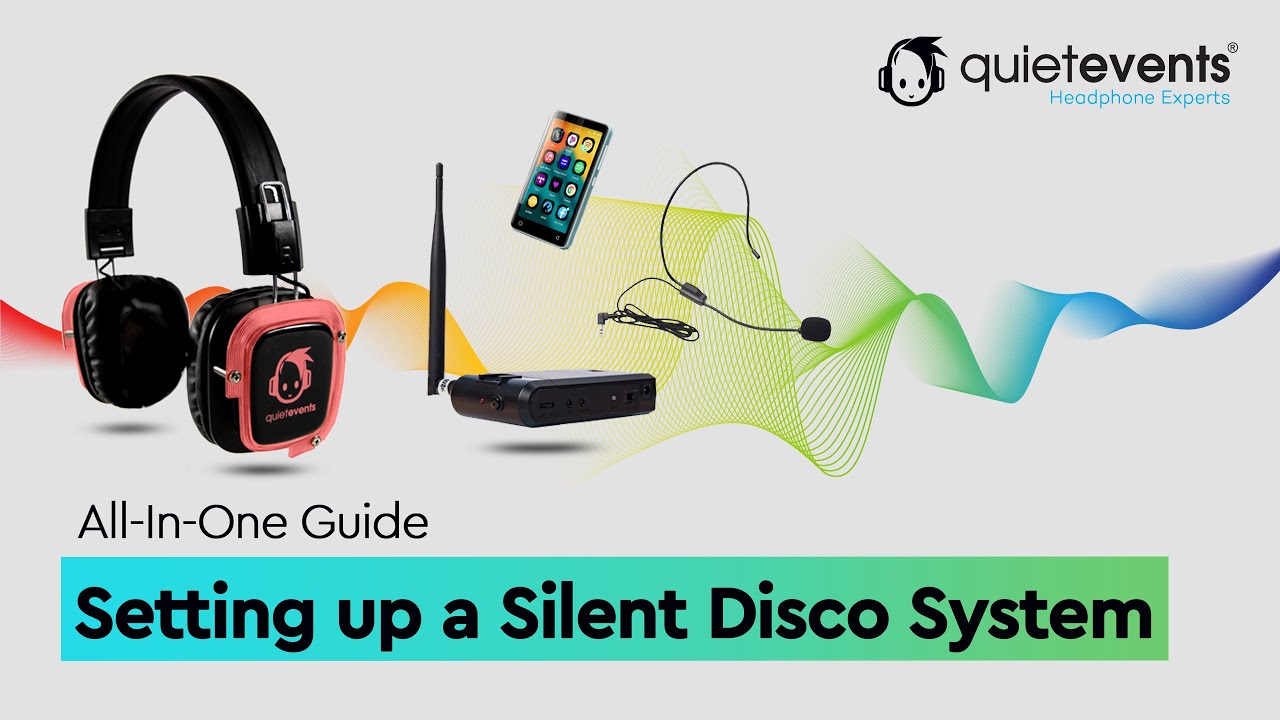
Connecting is simple — the system is made to be plug-and-play in four easy steps.
- Connect the audio source to the transmitter. This can be done with a cable (make sure you have the right one for your phone, laptop, or DJ equipment). Quiet Events provides an all-in-one cable to make it simple for Apple or Android phones.
- Turn on the transmitter and choose a channel. Each transmitter must be on a different channel to work correctly.
- Play the music on the audio player. Don't forget to turn the volume up on the player.
- Turn on the headphone and tune to the same channel number as the transmitter. Don't forget to turn the volume up on the headphone too.

🎧 What is a silent disco, and why this guide exists
A silent disco is an event concept where people dance, sing, and socialize together while listening to live music through specialized wireless headphones rather than a traditional loudspeaker system.
This style of party started in the late 1990s as a noise-ordinance workaround for after-hours underground dance parties. It now powers corporate breakouts, simultaneous interpretation at the UN, fitness classes, museum tours, weddings, and silent conferences with thousands of attendees.
Two ultimate guides currently dominate the search results: Retekess's product-led overview and silent-disco-rental.com's how-to. Both are useful starting points. Neither covers the equipment decisions that actually move the needle at scale. This guide does. We wrote it because the most common questions we field from event planners are still about the basics. What do I need. How do I set it up. Where do I get it. What does it cost.
This guide walks through every part of that chain: what hardware you actually need, which system to rent, how to set it up, how much it costs, when DIY is fine, when it isn't, and what to look for in a rental partner. It pulls from 15+ years of Quiet Events deployments at events ranging from backyard weddings and large silent parties at Lincoln Center in NYC to 1,000+ person Bonnaroo festival activations, plus the silent-conference work we've done for Amazon with tens of thousands of headphones, Google, NYU, and even the Met Opera.
We're an audio technology company, not a party company. Everything below is written from the equipment side first.

What equipment do you need for a silent disco?
1. Wireless RF headphones. One per attendee. Each headphone has a built-in receiver tuned to the transmitter's frequency, plus a channel selector and volume control. The professional standard is RF (radio frequency) in either the 900 MHz or 600 MHz UHF band in North America and most South American countries, while other regions vary — Europe uses 500 MHz, and Asia and Africa differ depending on local RF regulations. Headphones do not use Bluetooth or Wi-Fi; neither can scale to thousands of headphones with simultaneous audio in large spaces. Note: there are several different styles of silent disco headphones, and Quiet Events offers the largest range for both home and pro audio environments. Check out Choosing the Right Silent Headphone System for Your Event to make the right choice.

The Ultra2 headphone has a 3-channel party mode that calls out “red, blue, and green” so you know which channel you're on without looking, plus a 10-channel mode for larger corporate events. It includes a digital channel display, an audible channel indicator (ADA-compliant), 10 LED colors, and a 3.5mm jack for in/out. It's the conference and multi-language workhorse.

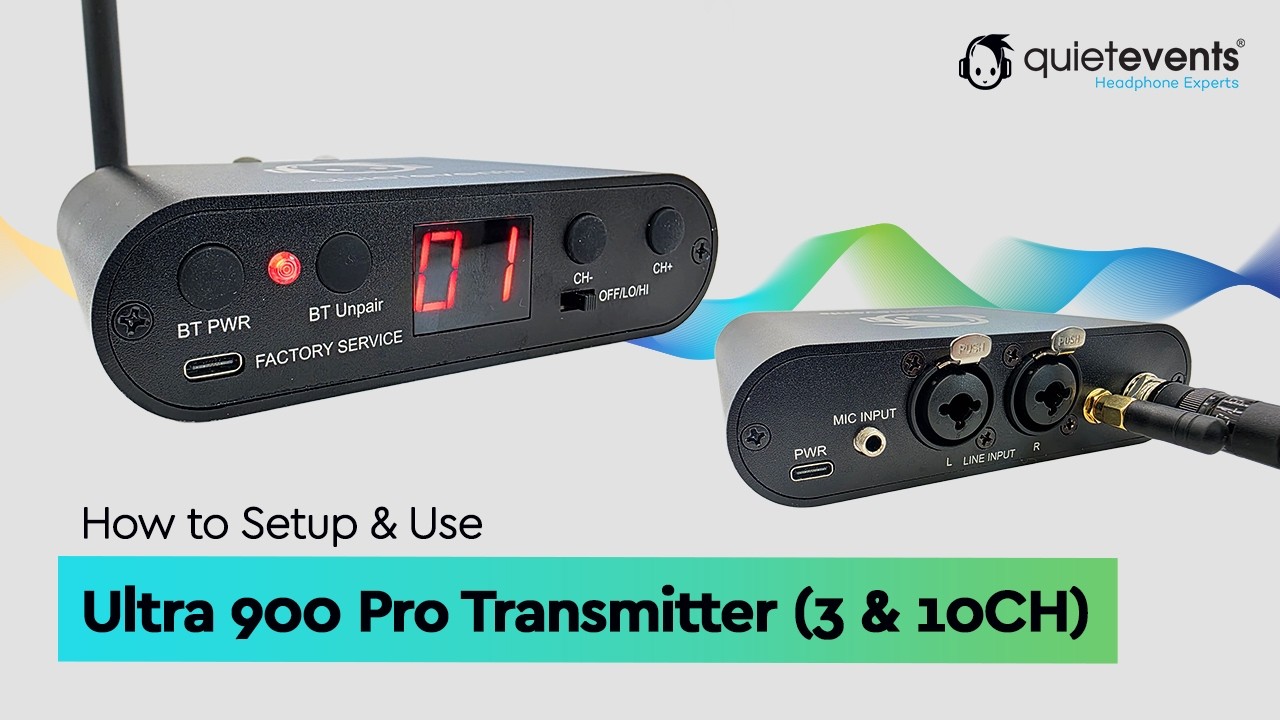
2. RF transmitters. You'll need one transmitter per audio channel. A three-channel event needs three transmitters; a silent conference or meeting with 10 stages needs 10. Two transmitters can't be in the same location on the same channel number — that causes static. The transmitter takes line-level audio from a DJ mixer, laptop, or interpreter feed and broadcasts it on the assigned frequency. There are home/consumer transmitters and corporate/professional transmitters; both work, but they offer different features, and not all silent disco companies offer multiple styles. Quiet Events, for example, offers an Ultra headphone with both Ultra Home and Ultra Pro transmitters. The Home is easy to use, with a digital display, a belt clip to be worn, and a microphone, while the Pro series offers XLR standard audio inputs for pro audio setups.

The Ultra 900 Pro transmitter broadcasts 13 simultaneous channels on 900 MHz, with XLR and 3.5mm inputs and a 12-hour internal battery.
A few specs that matter across all five systems:
- Range: Up to 1,500 feet (line-of-sight, indoor or outdoor)
- Latency: Under 10 milliseconds (imperceptible to the human ear)
- Spectrum: 900 MHz or UHF. No conflict with venue Wi-Fi or 2.4 GHz wireless mics
- Inputs: RCA and 3.5mm. Plug in any source
3. An audio source. Anything with an RCA, 3.5mm, XLR, or even Bluetooth output works: DJ mixer, laptop, phone, interpretation console, audio interface. Silent disco transmitters are device-agnostic; all they need is an audio feed. Some transmitters also include a microphone so you can talk over the audio to everyone wearing a headphone on that transmitter's channel.
4. Chargers for silent disco headphones. Depending on the style, headphones with 10–12 hour batteries need to be charged after events. The connection could be USB micro, USB-C, or barrel charging. Only one headphone style — the Ultra series — offers fast charging over USB-C, charging a headphone in under 3 hours for a full 12+ hour day of use. With fast-charging hubs, you can charge 48 headphones at a time.
5. A check-in / check-out workflow. For public events where headphones could walk off, plan a system to track them. Some states make it illegal to collect IDs, and some venues won't let you take security deposits — so look at systems like ChxItOut, which offers a wide range of ways to associate a headphone with a person so you get them back after the event.


What is the best silent disco system to rent or buy?

If you're trying to decide between systems, the practical question is: how many simultaneous audio tracks will play in the same physical space? A wedding with one DJ needs one channel. A corporate conference with four breakout tracks needs four. A six-language event needs six interpreter feeds. The flow diagram above helps you understand which silent disco headphones and systems are available and which transmitter is best for your needs.
For a deeper look at the headphone hardware itself, including which competitor models are rebranded versions of the same Chinese chassis, see our companion piece: What is the best silent disco headphone? A 2026 buyer's guide.
Who is the best silent disco company to rent from?
Short answer: choose a multi-channel RF rental partner that has the right style for you, enough inventory to scale, charges no security deposit, and ships on a guaranteed timeline. Long answer below.
The category has consolidated around four or five real providers. The rest are resellers running on borrowed inventory. Here are the differences that matter when you compare them.
Inventory depth. A 500-attendee event needs 500 headphones in one place, charged, tested, and shipped together. Most rental companies have 1,000–3,000 units total across all warehouses. Quiet Events operates a fleet of 30,000+ headphones across nine US logistics hubs, two Canadian hubs, and 22 international partner locations. That depth is what makes festival-scale deployments possible (Bonnaroo, US Open, NASCAR).
Equipment library. Most rental companies offer one system, usually three-channel. If your event grows past three audio tracks, you're stuck. Quiet Events operates 12 distinct equipment styles that broadcast up to 70 simultaneous frequencies across the platform. The 45-channel Max transmitter alone covers most multi-language conferences. The other 11 systems cover everything from fitness classes to two-way guided tours.
Channel count. Three channels is the floor. Most corporate, conference, and translation work requires 10 or more. Whoever you rent from, confirm the channel count of their transmitter, not just the headphone.
Security deposits. Most rental competitors hold a $350+ security deposit upfront. Quiet Events charges zero deposit, ever. On a 100-headphone single-day rental, that's a $1,000-vs-$738 upfront difference (more on cost in the next section).
Customer Success availability. Events happen on weekends and at 9 PM and on holidays. A rental partner that closes at 5 PM Eastern Friday is useless when a transmitter loses power on Saturday night. Our Customer Success team is staffed 24/7 by active event planners. Not a chatbot, not a queue.
Guarantees in writing. Quiet Events backs every rental with a 110% Satisfaction Guarantee covering price match (we refund 110% of the difference), timely shipment (we refund 110% of the total order if equipment arrives outside the 7–10 day window before your event), and stock availability (110% credit toward the next engagement if a stock conflict arises). The category's strongest written guarantee.
For a corporate event, conference, festival, university activation, or anything with more than three audio channels, the practical recommendation is the Quiet Events 10CH Ultra or the 3 & 10CH Ultra 2. Both run on 900 MHz, both support 13 simultaneous channels, and both pair with our Ultra series headphones (10–12 hour battery, 1,500-foot range, less than 1% distortion).
For weddings, fitness classes, or any single-DJ event, the 3CH Party System is the standard pick. Same headphones, smaller transmitter, lower cost.
How much does silent disco equipment cost?

Pricing splits cleanly between rental and purchase. We'll cover both, then show the per-attendee math that comes up most often.
Rental rates (Quiet Events, 2026)
We publish a transparent multi-day rate card. Per-headphone rates step down significantly after Day 1 because shipping and handling are front-loaded.
| Day | Standard equipment | Premium equipment (multi-channel / 45 Max) |
|---|---|---|
| Day 1 | $7.00 / headphone | $12.00 / headphone |
| Day 2 | $3.50 / headphone | scales proportionally |
| Day 3+ | $2.75 / headphone / day | scales proportionally |
A few line items often get missed:
- A 10% industry discount applies to several verticals (universities, religious organizations, nonprofits, fitness studios). With the discount, the lowest Day 1 rate drops to $6.30 per headphone.
- Transmitters are $40 each, billed separately. Most quotes from competitors bundle a transmitter into the per-headphone rate, which makes a direct comparison hard. Ours are listed as a separate line so you can see exactly what you're paying.
- Free shipping nationwide. No hidden freight charge.
- Free curated music library, with pre-mixed playlists across genres so you can run an event without a DJ.
- No security deposit, ever. Most rental competitors charge $350+ upfront. We charge zero.
- Replacement fees on lost or damaged units run $50–$80 per unit. Rental insurance is available.
Upfront cost comparison (100 headphones + 3 transmitters, 1 day)
The headline value comparison. The one number that surprises planners most.
- silent-disco-rental.com: $650 rental + $350 security deposit = $1,000 upfront
- Quiet Events: $820 ($700 in headphones + $120 in transmitters), or $738 with the 10% industry discount, no deposit
Purchase pricing
If you host events more than three times a year, ownership starts to pencil out.
- Single headphone purchase, entry tier: roughly $40–$80 per unit at quantity, depending on chassis (RF-309 vs RF-890)
- Single transmitter purchase: $140–$500 depending on channel count (3-channel up to 45-channel)
- Complete starter kit (10 headphones + 1 transmitter): $500–$1,200
- Mid-scale kit (50 headphones + 1 multi-channel transmitter): $3,500–$6,500
- Professional fleet (200+ headphones + multi-channel transmitter): $15,000+
A note worth flagging: most “headphone models” sold by competitors are the same underlying chassis with different brand stickers. The Retekess TA003, Sound Off GLO 3, Silence Onyx, and Quiet Events Pulse Party are functionally the same hardware. The differences are inventory depth, frequency calibration, customer support, and warranty. We walk through this in detail in the headphone buyer's guide.
Per-attendee math (the question planners actually ask)
For a single-day event, here is what 1 headphone per attendee actually costs:
| Attendees | Day 1 rental (standard) | With 10% industry discount | Plus 1 transmitter |
|---|---|---|---|
| 25 | $175 | $157.50 | + $40 |
| 50 | $350 | $315 | + $40 |
| 100 | $700 | $630 | + $120 (3 transmitters) |
| 250 | $1,750 | $1,575 | + $120 |
| 500 | $3,500 | $3,150 | + $120 |
| 1,000 | $7,000 | $6,300 | + $200 (5 transmitters) |
On a multi-day event, the Day 2 and Day 3+ rates cut the headphone line by 50% and 60% respectively. A three-day corporate conference for 300 attendees lands around $4,235 in headphone rental ($2,100 Day 1 + $1,050 Day 2 + $825 Day 3 + $120 transmitters), with the 10% discount bringing it under $3,900.
How to set up a silent disco event, in depth, for event planners (step by step)

The setup is straightforward once you know the sequence. The mistakes are predictable, so we'll flag them as we go.
Step 1: Confirm venue dimensions. Pace the longest dimension of the room or outdoor space. Each Quiet Events transmitter covers up to 1,500 feet line-of-sight. For most venues (ballrooms, fitness studios, hotel meeting rooms, outdoor pavilions), one transmitter is enough. For stadium concourses, multi-floor activations, or anything beyond 1,500 feet, plan a transmitter per zone with frequency coordination.
Step 2: Place the transmitter. Mount the transmitter as high and central as possible. Higher placement reduces signal blockage from bodies in the crowd. Central placement minimizes the maximum distance to any headphone. A folding table at the back of the room is fine for small events; a truss-mounted rig is standard at festivals.
Step 3: Connect the audio source. Run XLR, RCA, or 3.5mm from your DJ mixer, laptop, interpreter console, or audio interface into the transmitter's input. Test the line level by playing a known reference track. If the transmitter has a peak indicator, set the source so it peaks just below clip on the loudest passage.
Step 4: Confirm channel assignment. If you're running multiple tracks, label each transmitter channel with its source (“Channel 1: DJ Main,” “Channel 2: Hip-Hop Room,” “Channel 3: Spanish Interpretation”). Print the channel guide and hand it out at headphone distribution.
Step 5: Test headphones before distribution. Power on five or ten headphones, tune each to every channel, and walk the perimeter of the venue. Listen for dropouts, static, or audio bleed between channels. Adjust transmitter placement if any channel has weak spots.
Step 6: Set the volume reference. Source music should be loud enough that a headphone at 50% volume sounds full. This gives every attendee headroom in both directions. Match volume across all channels so attendees don't get blasted when switching.
Step 7: Distribute and track. Set up a check-in table with the channel guide, sign-out sheets or barcode scanner, and (optionally) a deposit on driver's license or student ID. Quiet Events rentals ship with the ChxItOut loss-reduction system included, which automates this step.
Step 8: Monitor during the event. Walk the floor. Spot anyone fiddling with channel buttons (often a sign of weak signal in their location). Keep spare transmitters and a few extra headphones at the check-in table for swaps. Our Customer Success team is reachable 24/7 if anything goes sideways mid-event.
Step 9: Collect and pack. After the event, collect headphones at the same table they were handed out from. Reconcile against the sign-out list. Pack headphones back into the charging cart for return shipping. Quiet Events provides return labels and pre-scheduled FedEx pickup.
Common mistakes & troubleshooting
I hear static when I turn on the headphone. If all your transmitters are off (not just unplugged — they have internal battery power), another device may be broadcasting on that frequency; find it and turn it off. Next, check that you have only one transmitter on that channel — two transmitters on the same channel will cause static.
Don't place the transmitter behind the DJ booth, TVs, or screens. Booths often have metal racks and bodies blocking line-of-sight. Mount the transmitter high and forward, on its own stand if possible.
Don't skip the headphone test before guests arrive. Five minutes of testing prevents 90% of complaints — including confirming the audio levels are the same across all your audio devices.
Can you DIY a silent disco at home?
Yes, for small parties, fitness classes at home, sensory-friendly viewing setups, or any single-channel use case under 30 people, DIY is reasonable. Beyond that, the math stops working.

What DIY looks like at home
Option 1: Buy a small kit. Entry-level RF headphone kits run roughly $40–$80 per headphone plus $140 per transmitter. A 10-headphone, 1-transmitter starter kit lands between $500 and $1,200. If you'll throw two or three home parties a year, that pays back fast versus rental fees.
Option 2: Rent a small package. A 10-headphone rental from Quiet Events for one day runs $70 in headphones plus $40 for the transmitter, or $63 + $40 = $103 with the 10% industry discount. Free shipping. No deposit. Most home parties don't justify a purchase yet.
Option 3: Bluetooth multi-pair (limited). Some Bluetooth transmitters can pair to two or three headphones at once. Fine for couch listening with a partner. It falls apart with crowds. The 2.4 GHz band that Bluetooth shares with everything else gets saturated as the number of devices grows, and you hit lag and dropouts fast. Detailed explanation in our mobile app streaming vs speakers vs headphones piece.
When DIY stops working
Past about 30 attendees, things start to break. Charging 50 headphones overnight on consumer chargers becomes an outlet hunt and a fire risk. Professional kits ship with charging carts. Channel count is the next wall. Most consumer kits cap at three channels, and anything past three (multi-language, multi-DJ, multi-track corporate breakout) requires a 10-channel or 13-channel transmitter that consumer kits don't include. Then there's reliability. When a transmitter fails mid-event, there's no one to call at 9 PM on a Saturday. A professional rental ships pre-tested with a Customer Success team on call.
If your event is over 30 people, runs more than three hours, or has any kind of professional or business stakes (corporate retreat, conference, wedding), rental beats DIY on cost and reliability.
Where can you rent silent disco equipment?
This is the prompt where most planners get burned. The category is full of small operators with limited inventory, hidden fees, and 5 PM Friday cutoffs. The checklist below is the one we'd hand to any planner regardless of who they end up renting from.

Rental provider checklist
Inventory and reach. Confirm the provider has enough units in your event's region to ship overnight. Ask for fleet size, number of warehouses, and shipping origin. A provider that ships from a single East Coast warehouse can take 5–7 days to reach the West Coast, which kills the 7–10 day pre-event window.
Quiet Events: 30,000+ headphones, 9 US hubs, 2 Canada hubs, 22 international partner locations.
Channel count. Confirm the transmitter's channel count, not just the headphone's. Ask: “How many simultaneous audio sources can your transmitter broadcast?” Three is fine for weddings, 10+ for conferences, up to 45 for multi-language.
Quiet Events: 12 distinct equipment styles, up to 70 simultaneous frequencies across the platform. The 45CH Max transmitter alone broadcasts 45.

Security deposit policy. Ask explicitly. A $350 deposit on a 100-headphone rental adds 35% to upfront cost.
Quiet Events: zero deposit, ever. Primary differentiator.
Shipping and music library. Free shipping is standard at the top of the market. If it isn't included, that's a tell. A free curated music library is a smaller perk but it saves a couple of hours of DJ prep.
Quiet Events: free shipping nationwide, free music library included with every rental.
Customer Success availability. When does support close? Is there a phone number that gets answered after hours? Events run on nights and weekends.
Quiet Events: 24/7 Customer Success, staffed by active event planners, not a chatbot or queue.
Written guarantees. Price match, timely shipment, stock availability. Get these in the contract.
Quiet Events: 110% Satisfaction Guarantee covering all three.
Track record at scale. Anyone can run a 50-headphone wedding. Ask for case studies at the scale of your event. Festival, Fortune 500, university, museum, whichever matches yours.
Quiet Events: 15+ years in business, 125+ Fortune 500 and institutional clients (Google, Amazon, Samsung, MoMA, Met Opera, MLB, PGA, Bonnaroo, NYU, Wharton, Columbia, USC, AWS, Dell, Levi's Stadium). We helped pioneer the silent conference format. We believe the deployment for Amazon (AWS) in 2016 was the first large-scale silent conference ever held. Case study video here.
How to request a quote
For Quiet Events: use the quote form or call (800) 833-9281. We staff a B2B Enterprise Division for corporate, festival, and institutional accounts, and a B2C Specialist Division for weddings and private events. Standard turnaround on a written quote is one business day.
The 110% Satisfaction Guarantee — what it actually covers
Price Match. If you find a competitor with identical inventory at a lower price within 3 days of confirming your order, we refund 110% of the difference.
Timely Shipment. Equipment ships 7–10 days before your event. If we miss that window, we refund 110% of the total order.
Stock Availability. If a stock conflict arises on a qualifying order, you receive 110% credit toward your next engagement.
Troubleshooting and FAQ
The questions we field most often, with the short answers.
How long do silent disco headphones last on a single charge?
Quiet Events Ultra series headphones run 10–12 hours of continuous use on a single charge. Most full-day events finish with battery to spare. For multi-day events, the charging carts hold full fleets overnight.
What happens if it rains or the venue is outdoors?
RF transmission isn't affected by weather. The headphones themselves are not waterproof but are splash-resistant. For festivals or outdoor weddings, we recommend a covered DJ booth and instruction to attendees to remove headphones in heavy rain.
What if my venue has bad Wi-Fi or strong 2.4 GHz interference?
This is exactly why we use 900 MHz RF instead of Wi-Fi. Our equipment doesn't share spectrum with venue Wi-Fi, 2.4 GHz wireless mics, or Bluetooth devices. Interference is functionally zero.
How do I prevent headphones from walking off?
Three options that work: check IDs at distribution (driver's license, student ID), use barcode scanners with sign-out sheets, or use the ChxItOut loss-reduction system that ships standard with Quiet Events rentals. Loss replacement runs $50–$80 per unit.
Can a DJ use their own mixer with the transmitter?
Yes. The transmitter accepts standard RCA or 3.5mm line-level audio from any DJ mixer, controller, laptop, or audio interface. No proprietary cabling required.
What about simultaneous interpretation?
Each language gets its own channel. The Ultra series transmitter supports 13 simultaneous channels, so a bilingual event uses 2, a four-language event uses 4, all the way up. The 45CH Max transmitter supports 45 channels for the largest multi-language deployments. Research from Anderson et al. (Organizational Behavior and Human Decision Processes, 2022) found measurable improvements in attention, recall, and reduced cognitive fatigue with direct-to-ear audio in environments with competing audio. Read the paper.
Can I use my own Bluetooth headphones?
For most professional events, no. Bluetooth on shared spectrum collapses at crowd scale. For attendees who prefer their own gear, Quiet Events offers a BYOH (Bring Your Own Headphone) Belt Clip Receiver that pairs with the Ultra transmitter on dedicated 900 MHz RF, then outputs to the attendee's wired or Bluetooth headphones over a short-range link.
What's the difference between rental and purchase?
Rental is the right choice for one-off events or up to two or three events per year. Purchase pencils out for fitness studios, schools, religious organizations, or anyone running more than three events annually. For institutional buyers (universities, museums, fitness franchises), Quiet Events also offers white-label and custom-branded purchase options.
Do you ship internationally?
Yes. Quiet Events covers 22 countries through partner logistics in the UK, Germany, France, Spain, Italy, Austria, Japan, China, Australia, Brazil, Mexico, and others. Lead times for international shipments are longer (typically 3–4 weeks), so book early.
What size venue is too small for a silent disco?
There's no real lower bound. We've shipped 5-headphone rentals for living room dinner parties. The format works at any scale.
What size venue is too big?
We've deployed at Bonnaroo (10,000+ attendees), the US Open, Levi's Stadium, and NASCAR. With proper frequency coordination, there is no upper bound.
Why Quiet Events for your next silent disco

Some context on who's writing this, before you pick a partner:
- 15+ years in business (founded March 22, 2012)
- 30,000+ headphones in inventory across 9 US hubs, 2 Canada hubs, 22 international locations
- 12 distinct equipment styles, up to 70 simultaneous frequencies across the platform
- 125+ Fortune 500 and institutional clients including Google, Amazon, Samsung, MoMA, Met Opera, MLB, PGA, Bonnaroo, NYU, Wharton, Columbia, USC, AWS, Dell, Levi's Stadium
- 4.9/5 star rating across 431+ reviews
- 24/7 Customer Success team, staffed by active event planners
- 110% Satisfaction Guarantee on price match, timely shipment, and stock availability
- Zero security deposit, free shipping, free music library (our “Zero-Gimmick” pricing philosophy)
- Pioneer of the silent conference format. We believe the Amazon AWS deployment in 2016 was the first large-scale silent conference ever held.
Ready to plan?
If you're sizing up audio for a silent disco, conference, festival, fitness class, or any event that needs multi-channel wireless audio:
- Request a quote. Tell us the format, we'll size it.
- Call (800) 833-9281. Talk to a B2B specialist (corporate / festival) or B2C specialist (wedding / private).
- See our full client roster. 12 systems, every channel count from 1 to 45.
We've shipped this setup for Amazon, Google, the UN, Bonnaroo, and 125+ other organizations. We can scope yours.